Per-User PACS Licensing and the Hidden Cost of AI
AI costs do not stop at the AI application itself.
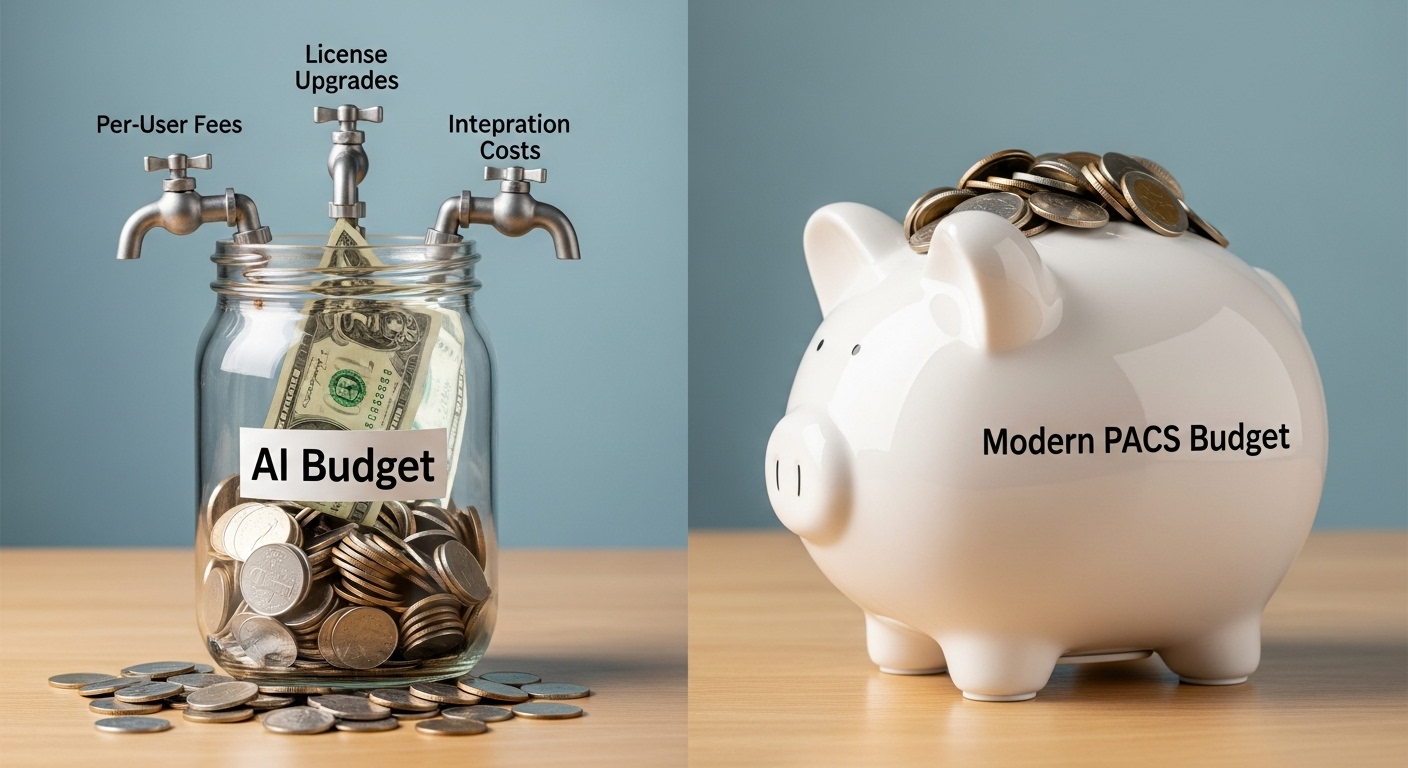
When imaging organisations evaluate AI, the budget often includes the software, implementation and integration. But the surrounding PACS environment can also add cost through user licensing, interface fees, infrastructure and support.
That can make the real cost of adopting AI higher than the initial AI quote suggests.
AI budget is more than the AI licence
An AI project may introduce more than a new application. It can also involve:
- additional PACS users
- new integrations
- more sites or reading locations
- support and administrative access
- infrastructure requirements
- implementation and testing
- ongoing maintenance
These costs matter even more when an AI pilot expands into routine clinical use.
A project that begins with a small group of radiologists may eventually involve more readers, technologists, administrators, sites and connected systems.
The PACS commercial model can influence how much that expansion costs.
Where per-user PACS licensing can add cost
Per-user licensing can be straightforward when the number of users remains stable. But imaging environments rarely stay static.
Organisations may add:
- radiologists
- technologists
- support staff
- remote readers
- new locations
- clinicians who need imaging access
- external partners
If each additional user creates another PACS licence cost, the cost of expanding an AI-enabled workflow can increase alongside adoption.
The same issue can appear when organisations grow through acquisition, add new reading teams or expand teleradiology services.
AI can expose the limits of the commercial model
A PACS pricing model that works for a fixed team may become less predictable as new users, sites and technologies are introduced.
This matters when an AI project moves beyond the pilot stage. During a pilot, only a small number of users may need access. If the project succeeds, the organisation may want to expand it across more readers, departments or locations.
That is when PACS licensing, integration fees and infrastructure requirements can become part of the AI budget.
The question is not only:
How much does the AI application cost?It is also:
What else becomes more expensive when we deploy it?
Ask how your PACS treats AI and growth
Before approving an AI project, it is worth understanding how the existing imaging environment will affect the total cost. Ask your PACS vendor:
Does the AI application create another licensed user?
Some environments may treat services, integrations or additional access as another licensed connection or user.
Are integrations charged separately?
Ask whether connecting AI requires interface fees, professional services or recurring integration charges.
Do support and administrative users require licences?
AI adoption may involve more than radiologists. Technical, operational and support teams may also need access.
What happens when more sites are added?
An AI project that begins at one location may eventually expand across the organisation.
What changes when a pilot becomes enterprise-wide?
A successful pilot should not create an unexpected jump in PACS costs simply because more users start benefiting from the workflow.
Are support costs separate?
Understand whether support, upgrades and ongoing maintenance are included or billed separately.
Why unlimited-user licensing changes the equation
AdvaPACS does not charge per user or modality.
That means organisations can add users and modality connections without introducing another licence for each one. For AI projects, this can make the surrounding PACS cost easier to understand as adoption expands.
It also gives organisations more flexibility to involve additional radiologists, support teams or locations without treating every expansion as another licensing event.
The goal is simple: AI adoption should not become more difficult because more people need access to the imaging environment.
PACS architecture matters too
Licensing is only one part of AI readiness. The imaging platform also needs to support:
- data access
- interoperability
- workflow connectivity
- integration with external applications
- scaling as demand increases
- future changes in AI strategy
A PACS that is difficult to integrate with can introduce additional cost and operational effort, even if the AI application itself is straightforward to deploy.
AdvaPACS is built around open standards and APIs so AI and partner technologies can connect into the wider imaging environment.
Explore AI-Ready Enterprise Imaging
AI should fit the workflow
Adding AI does not automatically improve radiology.
If users need to leave the PACS, open another application, manage another worklist or manually move information between systems, the technology may create more work instead of less.
AI is most useful when it becomes part of the existing imaging workflow. That means evaluating not only the algorithm, but also:
- where results appear
- who needs access
- how studies move through the workflow
- what happens when the AI is unavailable
- how the application interacts with PACS and reporting
- how the workflow changes as use expands
Read: AI Should Work in the Background
What to evaluate before approving an AI budget
Before looking only at the AI vendor's price, consider the wider cost of deployment.
AI application cost
What does the AI software itself cost?
PACS licensing impact
Will adding users, services or locations increase PACS licensing?
Integration cost
Are interfaces, APIs or professional services charged separately?
Infrastructure requirements
Does the project require additional servers, hardware or cloud resources?
Support requirements
Who will manage and support the integration once it is live?
Scale-up cost
What happens to the total cost when the pilot expands across more readers and locations?
Understanding these costs early makes it easier to compare AI projects on their real operational and financial impact.
Build an imaging environment that makes AI easier to adopt
AI will continue to change.
The imaging platform around it should make it easier to add new capabilities, not create another barrier every time the organisation wants to expand.
AdvaPACS combines cloud-native architecture, open interoperability and an unlimited-user and modality model to give imaging organisations more flexibility as AI adoption grows.