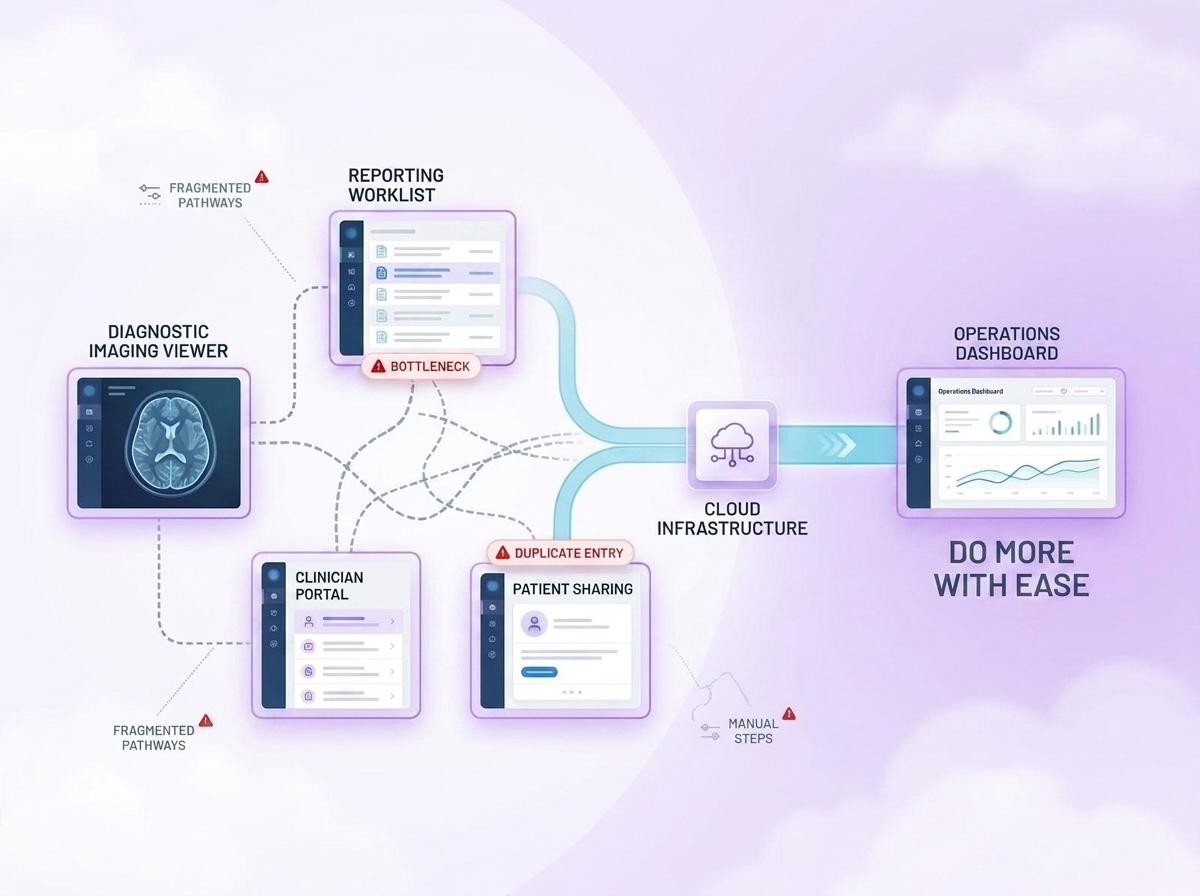
Broken workflows in imaging do not always look broken.
The studies still get read. Reports still get signed. Clinicians still request access. Patients still need images shared. Operators still find ways to keep everything moving.
From the outside, the workflow may look functional.
But inside the daily work, the experience can feel very different.
- A missing prior.
- Another login.
- A delayed handoff.
- A report waiting for context.
- A clinician waiting for access.
- A radiologist switching systems to complete one task.
Each issue may look small on its own. But across a full imaging operation, these small points of friction can drain focus, slow coordination, and make the work harder than it needs to be.
That is why the next step is not only asking imaging teams to move faster.
It is making the work easier to move through.
At AdvaHealth, we think of this as Do More With Ease.
When the workflow still moves, the problem is easy to miss
One of the hardest things about workflow friction is that the work often still gets done.
Radiologists adapt. Operators patch the gaps. IT supports the complexity. Clinicians find workarounds. Patients wait for access.
The issue is not always one major failure. It is the repeated effort required to keep disconnected parts moving.
A system may technically work, but still slow the person using it. A process may be possible, but still require too many steps. A tool may solve one problem, but create another handoff somewhere else. A workflow may continue moving, but only because people are carrying the burden behind the scenes.
This is where imaging operations become harder than they should be.
Not because teams are not working hard enough.
But because the workflow around them is asking too much.
Productivity is not the same as ease
Radiology has always cared about productivity.
- Turnaround time matters.
- Reading efficiency matters.
- Report volume matters.
- Operational performance matters.
But productivity metrics do not always show how much friction sits around the work.
A radiologist can read more studies and still lose focus from constant interruptions. A team can improve turnaround time and still depend on manual workarounds. An organization can add more tools and still make the overall workflow feel heavier.
That is why productivity alone is not the full answer.
How much unnecessary effort sits between the imaging team and the work they are trying to complete?
If the answer is “too much,” then the next improvement may not come from asking people to push harder.
It may come from removing what slows them down.
The real bottleneck is often context switching
In imaging, focus matters.
Radiologists are not just moving studies through a queue. They are interpreting information, connecting clinical context, making decisions, and communicating findings that affect care.
Every unnecessary switch in the workflow makes that harder.
- Switching systems.
- Searching for context.
- Waiting for access.
- Opening another screen.
- Repeating a step.
- Answering a request that should have been easier to resolve.
These are not always dramatic problems. But they interrupt the flow of work.
And when interruptions become normal, the workflow starts demanding more from the people inside it.
That is why reducing friction is not just a convenience issue. It is a workflow strategy.
Better imaging workflows are designed around the work
Doing more with ease does not mean imaging becomes simple.
Radiology will always involve clinical complexity, operational urgency, technical requirements, and coordination across many people.
But the systems around imaging can either add drag or reduce it.
A better imaging workflow should help teams:
- Access the right information faster
- Reduce avoidable interruptions
- Support radiologists, clinicians, patients, and external users
- Reduce manual workarounds
- Connect imaging workflows across the organization
- Scale without adding unnecessary operational weight
This is where enterprise imaging needs to move beyond simply adding more tools.
The future is not more screens, more portals, more handoffs, and more disconnected systems.
The future is a more connected imaging environment that supports the way teams actually work.
AI will only help if it reduces friction
AI is now part of almost every imaging conversation.
But AI will not reduce pressure if it becomes another layer of work.
If radiologists need to leave their workflow to check another tool, review another screen, or manage another alert, AI risks becoming one more source of friction.
The stronger direction is AI that works in the background.
AI should help surface what matters, support prioritization, reduce repetitive steps, and fit into the workflow without forcing teams to constantly change context.
But that requires the right foundation.
- AI needs connected imaging data.
- AI needs workflow integration.
- AI needs infrastructure that can scale.
- AI needs operational alignment.
In other words, AI-ready imaging is not only about the algorithm.
It is about whether the imaging environment around AI is ready to make work easier.
Cloud-native enterprise imaging can help reduce the drag
Cloud is often discussed as an IT topic.
Storage. Security. Performance. Uptime. Cost.
Those things matter. But for imaging teams, cloud also has a workflow impact.
A cloud-native enterprise imaging platform can help organizations deploy faster, scale more easily, support distributed users, and reduce the infrastructure burden that often sits behind imaging operations.
That matters because imaging is no longer limited to one department, one location, or one type of user.
- Radiologists need focus.
- Clinicians need access.
- Patients need sharing.
- Operators need control.
- IT needs confidence.
The organization needs a platform that can grow with demand without making the work harder to manage.
When the imaging platform is easier to connect, access, manage, and scale, teams can spend less energy fighting the workflow and more energy doing the work.
Less friction. More focus.
The pressure on imaging teams will not disappear.
Study volumes will continue to grow. AI will continue to evolve. Clinicians and patients will expect easier access. Organizations will continue looking for more efficient ways to operate.
The answer cannot be to keep adding more complexity around already busy teams.
The answer has to be a better way of working.
- Less interruption.
- Less workflow drag.
- Less infrastructure burden.
- Less tool overload.
- More focus.
- More access.
- More connection.
- More ease.
That is the direction behind Do More With Ease.
At AdvaHealth, we believe enterprise imaging should help radiologists, operators, and care teams move with less friction, not more.